A Window-Sill Palette for a Slow Afternoon
A window-sill palette helps you notice how daylight shifts around one object. Use a pencil sketch and clear comparisons to record what changes.
The common mistake with a window-sill palette is to name the colours too quickly, then stop looking. That costs you the specific changes in light, shadow and contrast that make an ordinary scene worth recording. Start with one patch of daylight, one nearby object and a pencil sketch.
Choose a small scene
Pick a windowsill or nearby surface where daylight falls in a clear patch. Settle on one object, such as a ceramic mug, a piece of fruit or a folded cloth. Too many items turn a focused study into an inventory.
Leave the scene as it is. The point is to notice the palette made by the light, the surface and the object, not to arrange a more attractive composition. If direct sun makes the bright area uncomfortable to view, look from a position where you can see the scene without staring towards the sun.
First, take in the whole patch. Find its brightest area, the transition into shade and the object’s cast shadow. These areas meet gradually; their boundaries and relationships are part of the palette.
Map light and shadow
Before writing colour names, draw a small rectangle for the lit area, outline the object and mark the shadow. Add a dot where the light seems strongest and a darker mark where the shadow appears deepest. This quick map gives each later note a location.
Compare areas instead of judging them alone. Is the object lighter or darker than the sill? Does its shadow look cooler, warmer or simply less bright than the lit surface? Words such as “dusty”, “creamy” or “smoky” can help, but a colour name is a prompt for attention, not a fixed identity.
Look at edges as well. A crisp shadow gives a clear boundary; a soft one seems to dissolve into the surface. A bright patch may have a sharp centre and a faint rim. These transitions help explain how a few colours can feel varied rather than flat.
Track daylight changes
Return to the same scene after a pause and add a second set of marks to your sketch. Note whether the bright patch has shifted, the shadow has changed shape or the object now stands out more clearly. Describe the new view on its own terms rather than forcing it to match your first note.
Clouds, nearby buildings, curtains and the angle of the sun can affect the light reaching the sill. You do not need to identify the cause. Record what you can see: the surface looks dimmer, the shadow edge is softer or the object separates more clearly from its background.
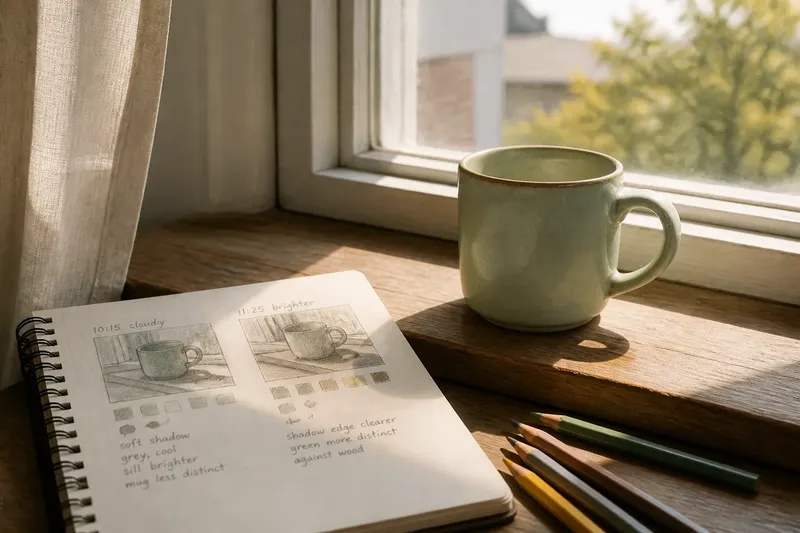
Say you have a pale green mug beside a wooden sill on a cloudy afternoon. In your first sketch, you mark the mug’s shadow as a soft grey shape and note that the sill looks brighter. Later, a brighter patch reaches the sill: you add a clearer shadow edge and write that the green appears more distinct against the wood. The resulting comparison is specific: the mug’s apparent colour stands out more as the light and contrast change, while the notes do not claim that its material colour changed.
Keep useful notes
Use a notebook and coloured pencils if you want a record, or write plain-language notes beside the sketch. A phone photograph can remind you of the layout, but its screen may alter brightness and colour. Treat it as a record of shapes and positions, not a faithful substitute for looking.
Make each note specific to its location. Instead of “grey shadow”, write “soft grey under the mug, with a faint warm edge”. Instead of “yellow light”, try “pale yellow near the sill’s front edge”. Location and comparison often say more than a single colour label.
- Check where the brightest patch falls; if it has moved, mark its new position, and if it has not, note that it stayed put.
- Check the darkest shadow; if it has shifted or deepened, redraw it, and if it looks unchanged, leave its outline as before.
- Check the shadow edge; if it is crisp, label it “sharp”, and if it fades into the sill, label it “soft”.
- Check one transition from light to shade; if you can see a gradual change, mark its direction, and if the boundary is abrupt, draw a clear edge.
- Check which part of the object catches the light; if a highlight is visible, mark its location, and if none stands out, note that the object appears evenly lit.
- Check the viewing moment; if the light or shadow has changed since your last look, add a time cue such as “after the cloud passed”, and if nothing is different, record “no visible change”.
Keep the record modest. A few observations leave room for another look; a page of elaborate names can draw your attention away from the scene.
What should you compare?
Should you start with the object or the light?
Start with the brightest patch, then locate the object in relation to it. This makes the shape of the light easier to notice before familiar ideas about the object take over.
Do you need precise colour names?
No. “Darker than the sill” or “soft-edged” is enough to begin. Use a more precise name only if it helps you compare one observation with another.
What if the daylight seems unchanged?
Compare the shadow boundary, the brightest point and the object’s contrast with its background. If none seems different, write “no visible change” and return later rather than inventing a shift.
Can you use a lamp instead?
Yes, but a lamp changes the subject of the exercise: it creates a local pool of light rather than a window-sill palette shaped by daylight. If you use one, note its position and compare the resulting shadow and lit area.
Keep each record local
A window-sill palette asks for attention, not a polished result. The same mug and sill can look different under another sky or from another viewing position, so keep each description tied to the moment and angle you observed.
For your next window-sill palette, leave the sketch beside the scene and add a short note when you see a change. The phrase “window-sill palette” is most useful when it points you back to a particular patch of light, its shadow and the object beside it.